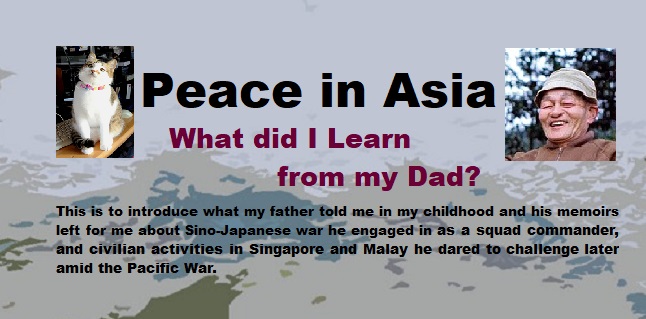
What made me get to work on this article?When I was a small child, my father, Harutaro Hirano, used to take a long nap after lunch at his homeland. After finishing it, he sat at a brazier and smoked. It was a warm-up activity, so to speak, before going out to work in fields. I begged him, “Dad, tell me a story, will you?” “Well, what would you like to hear about?” “How about your battles in the war or something like that?” He nodded with a smile and slowly started telling me about his experience in the war with China, and as was usual the case, moved to topics such as he had experienced in Singapore and Malaysia. I liked to hear his stories, since he was a good story-teller. The ones about war battles were most exciting for me as a small child, but I knew what he meant to say to me through his stories. It might have been such as “China is vast and great,” “Chinese people are interesting, so is Chinese language they speak,” “Singapore and Malaya are wonderful places to live in” and like that.
When my father reached around 70 years of age, I asked him to leave us in records his experiences during Sino-Japanese war and other incidents before and after that in his life. He accepted my request and he wrote on scraps of paper what he remembered. Fortunately his memory was still good enough to have me able to edit his stories one by one into total tree parts of his memoirs and completed them as ‘DREAMS OF JUJUBE TREES’ in series. My objective to for doing this was solely from my wishes for my sons, grandsons and such younger generations to use them for their future reference.
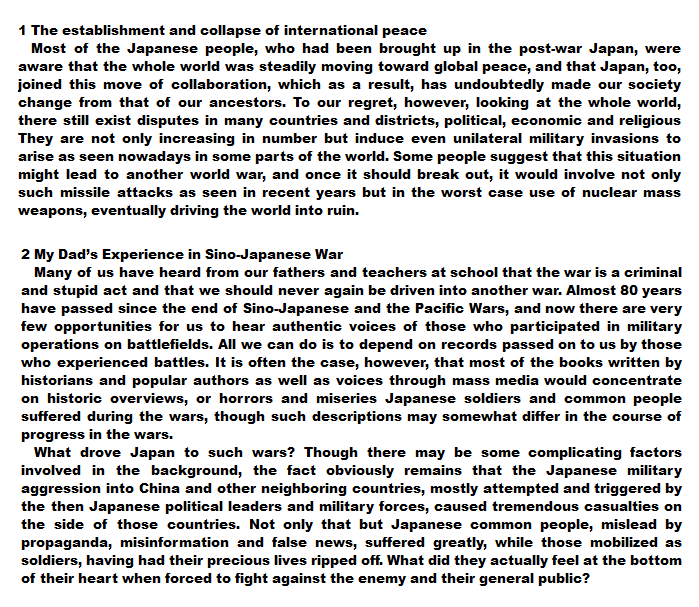
Many of us, who were brought up in the post-war Japan, have heard from our fathers and teachers at school that the war is a criminal and stupid act and that we should never be driven into another war. We believed that the whole world was steadily moving toward a global peace, and that Japan, too, reflecting on her past folly, joined this move of collaboration, which as a result, has made our society newly change from that of our ancestors. To our regret, however, looking at the existing world as a whole, there still exist disputes political, economic and religious in many countries and districts, which are not only increasing in number but even inducing unilateral military invasions to arise as seen nowadays in some parts of the world. Most of the records, books and voices around us in post-war Japan have consistently tended to concentrate on historic overviews, horrors and miseries caused by wars, or how to stop or avoid such. To our regret, nevertheless, does still remain the difficult problem how to achieve the genuine global peace unsolved in our societies.
When my father reached around 70 years of age, I asked him to leave us in records his experiences during Sino-Japanese war and other incidents before and after that in his life. He accepted my request and he wrote on scraps of paper what he remembered. Fortunately his memory was still good enough to have me able to edit his stories one by one into total tree parts of his memoirs and completed them as ‘DREAMS OF JUJUBE TREES’ in series. My objective to for doing this was solely from my wishes for my sons, grandsons and such younger generations to use them for their future reference.
Many of us, who were brought up in the post-war Japan, have heard from our fathers and teachers at school that the war is a criminal and stupid act and that we should never be driven into another war. We believed that the whole world was steadily moving toward a global peace, and that Japan, too, reflecting on her past folly, joined this move of collaboration, which as a result, has made our society newly change from that of our ancestors. To our regret, however, looking at the existing world as a whole, there still exist disputes political, economic and religious in many countries and districts, which are not only increasing in number but even inducing unilateral military invasions to arise as seen nowadays in some parts of the world. Most of the records, books and voices around us in post-war Japan have consistently tended to concentrate on historic overviews, horrors and miseries caused by wars, or how to stop or avoid such. To our regret, nevertheless, does still remain the difficult problem how to achieve the genuine global peace unsolved in our societies.

The Outline of my Father’s Stories The first item ‘SINO-JAPANESE WAR’ covers stories about battles on the Continent by my father, who was dispatched to the Chinese front on the Yangtze River as a squad commander of Fukuchiyama Infantry Regiment 120. The second one ‘SINGAPORE AND PLANTATION IN MALAYA’ covers various episodes about his exciting mission amid the Pacific War as a farming and agricultural advisor to the large-scale project in Malaya and his association with native people beyond racial differences. The third one ‘JAPANESE RURAL COMMUNITIES BEFORE THE WAR (MEIJI-TAISHO-SHOWA)’ describes Japanese rural communities and villagers, their daily lives, manners and customs, and their tendency toward pursuing pastimes, peacefulness and happiness. (For details, ref to Amazon Kindle e-books DREAMS OF JUJUBE TREES- FULL VERSION)
OUTLINE OF ‘SINO-JAPANESE WAR’
In 1938, Harutaro was dispatched to the Chinese front on the Yangtze River for four years as a squad commander of Fukuchiyama Infantry Regiment 120. His troop landed at Shanghai, moved to Huzhou, and arrived at Anqing in November. The previous month, the Japanese army had succeeded in occupying Wuhan district. The Chinese soldiers strongly resisted the Japanese army and frequently attacked them. In fierce battles over four years, he was hit three times in the body and eight more on a duffle bag, canteen, shovel and other things. Strange to say, what impressed him most on the battlefield of China was grandiose nature of China and people living there. Despite the wartime, he felt interested in Chinese language.
In the vicinity of their outpost, there was a pond of about 200 feet around. There were as many as 30 women coming to that pond for washing clothes every day. Harutaro picked up some Chinese phrases from the booklet and before some of the women, tried pronouncing them. Then, several women came up to him with a smile and kindly corrected his pronunciation. They sometimes burst into laughter when he made a strange pronunciation. Thus, he gradually made friends with those women. In three months or so, he got to be able to speak somehow what he wanted to say.
He also learned riding a horse. Galloping on a horse along the Yangtze River remained long in his heart as an unforgettable memory.
OUTLINE OF ‘SINGAPORE AND PLANTATION IN MALAYA’
After finishing his military duty in Sino-Japanese war on the Chinese battlefields, Harutaro left Kobe in August, 1944 with a fleet of steamships to Singapore to work as agricultural expert and advisor to the Malay Plantation Project. Though the Pacific War was intensifying, his heart bounded all through the voyage with expectation for the new land. For Harutaro, it was really a ‘fairy land.’
In Malaya, when a squall begins to fall, people get out of their house naked to ‘take a shower.’ The night sky is filled with beautiful stars. The Southern Cross is especially beautiful. From time to time, the sound of drums comes up. Close to the seashore, you see beautiful Malay girls dancing merrily. Their slow-tempo dance is really superb. In jungles you can enjoy seeing a lot of different animals.
The plantation Harutaro worked for was located at South Coast Mine in Johor Province. He cared for total 13 farms surrounded by jungles. He visited each farm and talked with youths in their offices until late at night. Even under the Japanese military occupation, local people were all friendly and warm-hearted toward him.
In early spring, 1945, Harutaro happened to work hard supplying foods for soldiers of ‘Kamikaze Boat Corps.’ The Japanese army asked him to offer help for those soldiers. When Japan’s defeat in the Pacific War was getting imminent, they finally asked him, to try to find the Communist Headquarters in jungles and get into it.
OUTLINE OF ‘JAPANESE RURAL COMMUNITIES BEFORE THE WAR (MEIJI-TAISHO-SHOWA)
It contains some episodes Harutaro heard from his dear grandmother about his ancestors, who had lived since the middle of the Edo period.
In the Edo era, there existed in Japan a rigid class system based on the four occupations, that is, warriors (feudal lord and samurai), farmers, artisans, and merchants. Farmers, suffered from heavy land taxes, poor crops and even worse, great famines that periodically struck them. The Meiji government set about aggressively pursuing modernization and industrialization of her country, which tremendously changed the societies especially in large cities. Those changes somewhat changed the rural communities, too, but the destitute conditions of the farmers still continued even to the Showa period. Sticking to conventional manners and customs under such circumstances they pursued to find pastimes, peacefulness and happiness in their own simple lives.
In the Meiji and Taisho periods, Japan struggled to enter into a group of world powers. She won the Sino-Japanese War and Russo-Japanese War in the Meiji Period. In World War 1 in the early Taisho Period, Japan sided with the Allies. For some time after that, there had been no signs of another war to occur at least until the end of Taisho Period. It was during this period that Harutaro spent his childhood days. For him, the village was a ‘paradise’ filled with excitement and dreams.
As he grew up, however, he began to realize the reality of the village. He knew his ancestors, grandparents, and parents likewise had been destined to stay in the village as humble farmers throughout their lives. Harutaro wanted to get out of this small world of the village and pursue something new.
OUTLINE OF ‘SINO-JAPANESE WAR’
In 1938, Harutaro was dispatched to the Chinese front on the Yangtze River for four years as a squad commander of Fukuchiyama Infantry Regiment 120. His troop landed at Shanghai, moved to Huzhou, and arrived at Anqing in November. The previous month, the Japanese army had succeeded in occupying Wuhan district. The Chinese soldiers strongly resisted the Japanese army and frequently attacked them. In fierce battles over four years, he was hit three times in the body and eight more on a duffle bag, canteen, shovel and other things. Strange to say, what impressed him most on the battlefield of China was grandiose nature of China and people living there. Despite the wartime, he felt interested in Chinese language.
In the vicinity of their outpost, there was a pond of about 200 feet around. There were as many as 30 women coming to that pond for washing clothes every day. Harutaro picked up some Chinese phrases from the booklet and before some of the women, tried pronouncing them. Then, several women came up to him with a smile and kindly corrected his pronunciation. They sometimes burst into laughter when he made a strange pronunciation. Thus, he gradually made friends with those women. In three months or so, he got to be able to speak somehow what he wanted to say.
He also learned riding a horse. Galloping on a horse along the Yangtze River remained long in his heart as an unforgettable memory.
OUTLINE OF ‘SINGAPORE AND PLANTATION IN MALAYA’
After finishing his military duty in Sino-Japanese war on the Chinese battlefields, Harutaro left Kobe in August, 1944 with a fleet of steamships to Singapore to work as agricultural expert and advisor to the Malay Plantation Project. Though the Pacific War was intensifying, his heart bounded all through the voyage with expectation for the new land. For Harutaro, it was really a ‘fairy land.’
In Malaya, when a squall begins to fall, people get out of their house naked to ‘take a shower.’ The night sky is filled with beautiful stars. The Southern Cross is especially beautiful. From time to time, the sound of drums comes up. Close to the seashore, you see beautiful Malay girls dancing merrily. Their slow-tempo dance is really superb. In jungles you can enjoy seeing a lot of different animals.
The plantation Harutaro worked for was located at South Coast Mine in Johor Province. He cared for total 13 farms surrounded by jungles. He visited each farm and talked with youths in their offices until late at night. Even under the Japanese military occupation, local people were all friendly and warm-hearted toward him.
In early spring, 1945, Harutaro happened to work hard supplying foods for soldiers of ‘Kamikaze Boat Corps.’ The Japanese army asked him to offer help for those soldiers. When Japan’s defeat in the Pacific War was getting imminent, they finally asked him, to try to find the Communist Headquarters in jungles and get into it.
OUTLINE OF ‘JAPANESE RURAL COMMUNITIES BEFORE THE WAR (MEIJI-TAISHO-SHOWA)
It contains some episodes Harutaro heard from his dear grandmother about his ancestors, who had lived since the middle of the Edo period.
In the Edo era, there existed in Japan a rigid class system based on the four occupations, that is, warriors (feudal lord and samurai), farmers, artisans, and merchants. Farmers, suffered from heavy land taxes, poor crops and even worse, great famines that periodically struck them. The Meiji government set about aggressively pursuing modernization and industrialization of her country, which tremendously changed the societies especially in large cities. Those changes somewhat changed the rural communities, too, but the destitute conditions of the farmers still continued even to the Showa period. Sticking to conventional manners and customs under such circumstances they pursued to find pastimes, peacefulness and happiness in their own simple lives.
In the Meiji and Taisho periods, Japan struggled to enter into a group of world powers. She won the Sino-Japanese War and Russo-Japanese War in the Meiji Period. In World War 1 in the early Taisho Period, Japan sided with the Allies. For some time after that, there had been no signs of another war to occur at least until the end of Taisho Period. It was during this period that Harutaro spent his childhood days. For him, the village was a ‘paradise’ filled with excitement and dreams.
As he grew up, however, he began to realize the reality of the village. He knew his ancestors, grandparents, and parents likewise had been destined to stay in the village as humble farmers throughout their lives. Harutaro wanted to get out of this small world of the village and pursue something new.
What did I Learn from his Way of Life?WHAT IS MOST IMPORTANT IN ACHIEVING PEACE?
Harutaro, who grew up in the countryside, was, by nature, full of curiosity as my grandmother had pointed out. That seems to be why he was, even amid the war, moved by grandiose nature in China, Chinese language and people living there and a large-scale plantation, exotic landscape, animals in Malay and her people. He hated, even in his ordinary life, such things as racial prejudices, discriminations among people and class consciousness. He also disliked secretive behaviors and preferred open-mindedness. I am not confident enough how and when such character and view of life were nurtured in him, but imagine it came at least partly from his born-nature and the circumstances in which he had been brought up. I hope my sons, grandsons and our descendants would learn from him something worthwhile so as to live their own lives with bravery and happiness.
Harutaro, who grew up in the countryside, was, by nature, full of curiosity as my grandmother had pointed out. That seems to be why he was, even amid the war, moved by grandiose nature in China, Chinese language and people living there and a large-scale plantation, exotic landscape, animals in Malay and her people. He hated, even in his ordinary life, such things as racial prejudices, discriminations among people and class consciousness. He also disliked secretive behaviors and preferred open-mindedness. I am not confident enough how and when such character and view of life were nurtured in him, but imagine it came at least partly from his born-nature and the circumstances in which he had been brought up. I hope my sons, grandsons and our descendants would learn from him something worthwhile so as to live their own lives with bravery and happiness.





 父の日中戦争従軍記 MY DAD'S MEMOIR OF SINO-JAPANESE WAR